Planning a Da Nang motorbike rental? Compare bike types, understand licence and insurance rules, and learn what to check before you book and ride safely.
What a Da Nang Motorbike Rental Covers
A Da Nang motorbike rental is, at its simplest, a daily or weekly hire of a scooter or small motorcycle from a local shop, a hotel desk, or an online booking platform. It's the main way independent travelers reach Son Tra Peninsula's coastal loop, ride the switchbacks of the Hai Van Pass toward Hue, or just get from the Han River bridges to My Khe Beach without haggling over taxi fares every day. Compared to Hoi An, where many visitors just walk or cycle the Ancient Town, Da Nang is spread out enough that a bike genuinely changes what you can see in a day.
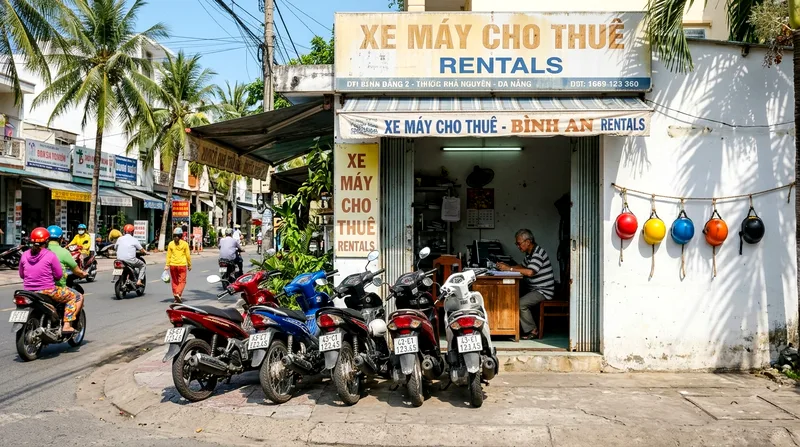
Rental here isn't tightly regulated like car hire in Europe. Shops range from small family-run operations with ten bikes parked on the sidewalk to slicker outfits with online booking, GPS tracking, and English-speaking staff. Prices vary by bike condition, season, and how long you rent — a bike kept for a month will cost less per day than one grabbed for a single afternoon.
How rental works in Da Nang
In practice, you pick a shop (in person or online), choose a bike, agree on a rental period, pay a deposit, and sign — or get shown — a contract, often a single printed page. Some shops require you to leave your passport; others accept a cash deposit instead, which is generally the safer option for you. You'll typically get one helmet included, sometimes two if you ask. Fuel is on you — a full tank runs a few hundred thousand dong depending on engine size, and you return the bike with roughly the same fuel level you received it. If you're staying more than a few days, ask about weekly rates up front, since many shops won't offer the discount unless you ask.
What Is Included and Excluded
This is where most disappointment happens, and it's almost always avoidable with five minutes of checking before you hand over cash. A rental "price" quoted by a shop or an app rarely includes fuel, parking fees at tourist sites, or any damage beyond normal wear. It also often excludes proper insurance — more on that below — which matters a lot given Da Nang's traffic mix of scooters, trucks, and increasingly aggressive intersections near the city center.
Ask explicitly what happens if the bike is damaged, stolen, or breaks down mechanically through no fault of yours. A reputable shop will have a clear answer, not a shrug.
Helmets, locks and basic gear
A helmet is legally required in Vietnam and should be included free with any rental — if a shop tries to charge extra for it, that's a bad sign. Quality varies wildly: some shops hand over a flimsy shell that meets the letter of the law but little else. If you're renting for more than a day or two, consider buying your own full-face or sturdier open-face helmet, widely available in Da Nang for a modest price, and using the shop's as backup. Most bikes come with a steering lock and sometimes a disc lock; ask how to use both, since theft of unlocked bikes from beachside parking is common enough to be worth the extra thirty seconds each time you park.
Hidden fees and damage liability clauses
Read the damage clause before you sign, not after something happens. Some contracts specify flat fees for common damage — a cracked mirror, a scratched panel, a flat tire — while others leave the amount to the shop's discretion, which is a red flag. Photograph the bike from all angles, including existing scratches and the odometer reading, before you ride off, and get the shop to acknowledge pre-existing damage in writing or via a timestamped photo they've seen. Avoid any shop that's cagey about this step or rushes you through it — that reluctance usually means disputes get resolved in their favor, not yours.
Bike Types and Rental Options Compared
The right bike depends on your route, experience, and how many people need to fit on it. For flat city riding around Da Nang's riverfront and beach road, a basic automatic scooter is plenty. For the Hai Van Pass or the steeper loops around Son Tra, a bit more power helps, especially two-up with luggage.
A 125cc automatic is the practical default for most visitors, while 50cc and larger motorcycles suit narrower use cases.
Da Nang motorbike rental options compared by engine size and rider type
| Bike Type | Best For | Hai Van Pass Suitability | Licence Complexity |
|---|---|---|---|
| 50cc scooter | Short city trips, beach runs | Weak on climbs | Lower, but still requires checking local rules |
| 125cc automatic | Most tourists, solo or couple | Good | Requires IDP or local licence in theory |
| 150–300cc semi-automatic | Confident riders, two-up with luggage | Very good | Requires valid motorcycle licence/IDP |
| 400–650cc manual motorcycle | Experienced riders, long Vietnam touring | Strong | Requires proven skill, often a motorcycle licence |
Typical categories only; always confirm legal requirements and bike availability directly with the rental shop or official sources before booking.
50cc, 125cc and 650cc explained
A 50cc scooter is the easiest category legally and practically — in some countries, including much of Europe, 50cc scooters can be ridden without a motorcycle licence, though Vietnam's own rules for visitors are stricter than that (see the licence section below). It's underpowered for hills and tends to struggle carrying two adults up to Hai Van Pass's higher bends. A 125cc automatic, the most common tourist rental, is the practical middle ground — enough power for the pass, easy to handle, and what most shops default to. Anything from 150cc up to the 650cc class — bigger manual motorcycles — is aimed at experienced riders wanting a specific feel or power for longer Vietnam touring beyond Da Nang, and typically requires showing real riding competence, sometimes a motorcycle-specific licence, before a shop will hand over the keys.
Daily, weekly and monthly terms
Daily rental suits visitors doing a short Da Nang stopover between Hoi An and Hue. Weekly rates drop the per-day cost noticeably and suit travelers based in Da Nang for a week while day-tripping to Ba Na Hills or along the coast. Monthly rentals, popular with long-stay digital nomads, often come with the steepest discount but also the least flexibility — damage policies and theft terms should be reviewed just as carefully, since a month is a lot more exposure to risk than a weekend. Always confirm current rates directly with the shop or booking platform rather than relying on numbers you've seen online, since fuel costs and seasonal demand shift pricing.
Licence and Insurance Rules for Travellers
This is the section most rental shops will gloss over because strict enforcement means fewer rentals. Legally, to ride any motorbike over 50cc in Vietnam, foreign visitors need a Vietnamese motorbike licence or an International Driving Permit (IDP) issued under the 1968 Vienna Convention that specifically covers motorcycles — and recognized by Vietnamese authorities. Many popular tourist nationalities, including the US, hold IDPs under the 1949 Geneva Convention, which Vietnam does not officially recognize for this purpose. In practice, this gray area is exactly why so many travelers ride without a technically valid permit — and why insurance claims and police encounters can get complicated. Confirm your home country's permit type and Vietnam's current requirements with an official source before you travel, not with a rental shop employee who just wants to rent you a bike.
International driving permit vs local licence
If your home country issued you a 1968-convention IDP with a motorcycle category, bring it along with your home licence. If not, some long-stay travelers go through the process of obtaining a Vietnamese motorbike licence, which requires a written and practical test and is a genuine commitment rather than a quick fix. Short-term visitors without a valid IDP commonly ride anyway, accepting the legal and insurance risk — this is a real trade-off you should make consciously, not by accident. If you're nervous about the legal gray zone, sticking to 50cc scooters, where rules in practice are sometimes looser, or hiring a driver instead, are reasonable alternatives.
Insurance, theft protection and accident steps
Don't assume "insurance included" means much — ask specifically what it covers: third-party liability, theft, your own medical costs, or just the bike's physical damage. Many budget rentals include none of this, leaving you liable for the full value of the bike if it's stolen or totaled. Separately, check whether your travel insurance policy covers motorbike accidents at all — a lot of standard policies exclude motorcycling outright, or only cover it if you hold a valid license for the vehicle class, which loops right back to the IDP question. If you're in an accident, the standard advice is: don't move the bikes if there's significant damage or injury, call the rental shop immediately, and contact local police for anything serious. Photograph everything before any vehicle is moved.
How to Book From Reputable Shops
Da Nang has a wide spread of rental operators, from international-style shops that cater heavily to tourists to small local counters you'll stumble across near the beach. Names like Tuan Motorbike Rental, Andy Motorbike, Tigit Motorbikes, TOM Motorbike Rentals, Da Nang Motorcycles, and Quang Nga Motorbikes Rental come up often in traveler reviews and forums — treat these as starting points to research, not recommendations, since quality and reliability shift over time and individual experiences vary. Read recent reviews, not just star ratings, and look specifically for comments about deposit handling and damage disputes, which tell you more than comments about bike condition.
Deposit, passport and payment checks
Many shops ask for either your passport or a cash deposit, sometimes both. Handing over your passport is common practice in Vietnam but carries real risk if the shop is disorganized or dishonest — you have far less use to dispute a damage claim with no passport in hand. Where possible, negotiate for a cash deposit plus a photocopy of your passport instead, especially at shops with strong, consistent reviews. Get a receipt for any deposit, cash or document, with the amount and date written clearly, and photograph it.
Delivery and pickup services
Motorbike rental delivery in Da Nang is widespread — many shops will drop the bike at your hotel and collect it at the end of the rental, which is convenient if you're staying somewhere outside the central tourist strip near My Khe Beach. This usually costs nothing extra within the city but may carry a fee for hotels further out near Son Tra or the airport. Confirm the exact pickup time and location in writing — a verbal "sometime in the morning" is a common source of wasted half-days waiting around.
Is Renting Worth It for You?
For many visitors, yes — but not for everyone, and it's worth being honest about that. Compared to Nha Trang or Phu Quoc, where beach resorts are more self-contained, Da Nang rewards mobility: Hai Van Pass, Son Tra, Hoi An Ancient Town, and Hue's citadel are all within striking distance by bike or short drive. But Vietnamese traffic is genuinely demanding for inexperienced riders, and a rental bike is not the place to learn.
Solo travelers, couples and families
Solo travelers and couples with prior scooter experience are the best fit — a 125cc automatic handles Da Nang's roads and the Hai Van Pass comfortably for two adults without excess luggage. Families with young children should think twice: car seats don't exist on scooters, and Vietnamese traffic density makes casual riding with a toddler a genuinely poor risk-reward trade. For that group, a private car with driver, bookable through most hotels or local tour desks, covers the same sights — Ba Na Hills, Hoi An day trips — with far less exposure.
Long stays and nervous riders
If you're staying a month or more, monthly rental rates make owning-a-bike-lite very affordable, and it's worth the extra time to find a shop with transparent damage terms rather than the cheapest daily rate advertised. If you've never ridden a motorbike, Da Nang's city traffic is a rough place to start — consider an organized half-day riding lesson some shops offer, or stick to being a passenger on guided Easy Rider-style tours, common across Vietnam, Hue, and Hoi An, instead of self-driving.
Frequently asked questions
Can I rent a motorbike in Da Nang without a licence?
In practice, many shops will rent to you without checking for a valid licence, especially for 50cc or 125cc scooters. Legally, though, you're required to hold a Vietnamese motorbike licence or a recognized International Driving Permit covering motorcycles. Riding without one exposes you to fines, complications after an accident, and likely denial of any insurance claim — it's a real risk, not just a technicality.
Do I need an international driving permit to ride in Da Nang?
Officially, yes, for anything above 50cc, and Vietnam only recognizes IDPs issued under the 1968 Vienna Convention with a motorcycle category — not the more common 1949 Geneva Convention permit many countries issue. Check your home country's IDP type before you travel, and confirm current rules with an official government or embassy source rather than a rental shop.
Do rental shops in Da Nang keep your passport as a deposit?
Many do, and it's common practice across Vietnam, but it's not without risk — you lose use in any damage dispute. Where the shop allows it, a cash deposit with a passport photocopy is the safer alternative. Always get a written, dated receipt for whatever you hand over.
Is insurance or theft protection included in a Da Nang motorbike rental?
Rarely by default, and "included insurance" often means only basic damage coverage, not theft or third-party liability. Ask the shop directly what's covered, and separately check whether your travel insurance covers motorbike riding — many policies exclude it or require a valid motorcycle licence for coverage to apply.
What is the difference between a 50cc and a 125cc scooter?
A 50cc scooter is lighter, slower, and struggles on steep sections like the upper Hai Van Pass, especially carrying two people. A 125cc automatic, the standard tourist rental, has enough power for hills and highway speeds while still being easy for less experienced riders to handle, which is why most shops push it as their default option.